Learning Outcomes
i. Understand the rationale behind endospore formation in bacteria
ii. Learn about bacterial motility and its mechanisms
iii. Study the structure of the bacterial flagellum
i. Bacterial Endospores
Bacteria are single-celled microorganisms that are found in a wide variety of environments. Some bacteria have the ability to form endospores, which are dormant structures that are resistant to harsh environmental conditions such as extreme heat, dryness, radiation, and chemicals. Endospore formation is a survival strategy that allows bacteria to survive in unfavorable conditions until conditions become more favorable for growth.
The formation of an endospore begins with the replication of the bacterial chromosome, which results in the formation of two identical copies of the DNA. One copy of the DNA is retained in the central region of the cell, while the other copy is moved to one end of the cell. The cell then begins to synthesize a thick, protective coat around the DNA, which is called the spore coat. The spore coat is made up of several layers of protein and other molecules that help to protect the DNA from damage.
Once the spore coat is fully formed, the cell enters a state of dormancy. This means that the cell stops all metabolic activity and growth. The spore can remain dormant for long periods of time, even for centuries.
When conditions become more favorable for growth, the spore will germinate. This means that the spore will reactivate its metabolic activity and begin to grow. The spore coat will break open, and the cell will emerge from the spore. The cell will then begin to replicate and divide, producing new cells.
ii. Bacterial Motility
Bacterial motility is the ability of bacteria to move. Bacteria can move in a number of different ways, including:
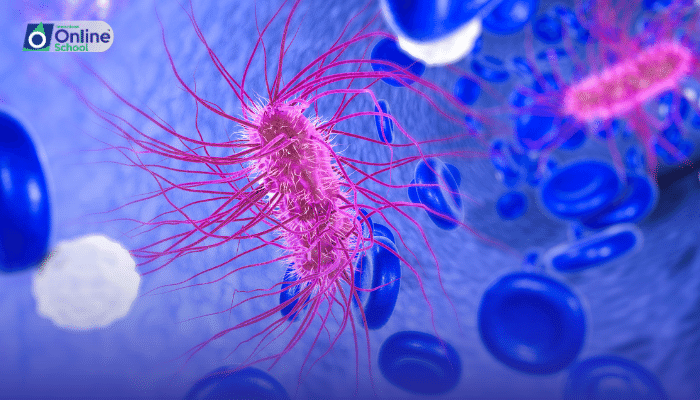
Flagella: Flagella are long, hair-like appendages that are attached to the surface of the bacterial cell. Flagella are powered by a rotary motor that is located at the base of the flagellum. The rotation of the motor causes the flagellum to whip back and forth, which propels the bacterium through the water.
Pili: Pili are shorter, thinner appendages that are also attached to the surface of the bacterial cell. Pili are not used for motility, but they are used for a variety of other functions, such as attaching to surfaces, exchanging genetic material, and forming biofilms.
Chemotaxis: Chemotaxis is the ability of bacteria to move towards or away from certain chemicals. Bacteria are able to detect chemicals in their environment using special receptors. When a bacterium detects a chemical that is beneficial to it, it will move towards the source of the chemical. When a bacterium detects a chemical that is harmful to it, it will move away from the source of the chemical.
Bacterial motility is an important survival mechanism for bacteria. It allows bacteria to move towards food sources, away from harmful substances, and to new environments where they may be able to find more favorable conditions for growth.
iii. Structure of the Bacterial Flagellum
The bacterial flagellum is a complex structure that is composed of several different parts. The main parts of the flagellum are:
Filament: The filament is the long, hair-like part of the flagellum that is visible under a microscope. The filament is made up of a protein called flagellin.
Hook: The hook is a curved structure that connects the filament to the basal body.
Basal body: The basal body is a complex structure that is embedded in the bacterial cell wall. The basal body contains a rotary motor that powers the flagellum.
The flagellum is a remarkable example of bacterial engineering. It is a complex and efficient machine that allows bacteria to move in a directed way.
Bacterial endospores and motility are two important adaptations that allow bacteria to survive in a wide variety of environments. Endospore formation allows bacteria to survive harsh environmental conditions, while bacterial motility allows bacteria to move towards food sources, away from harmful substances, and to new environments where they may be able to find more favorable conditions for growth.
